
 Author:
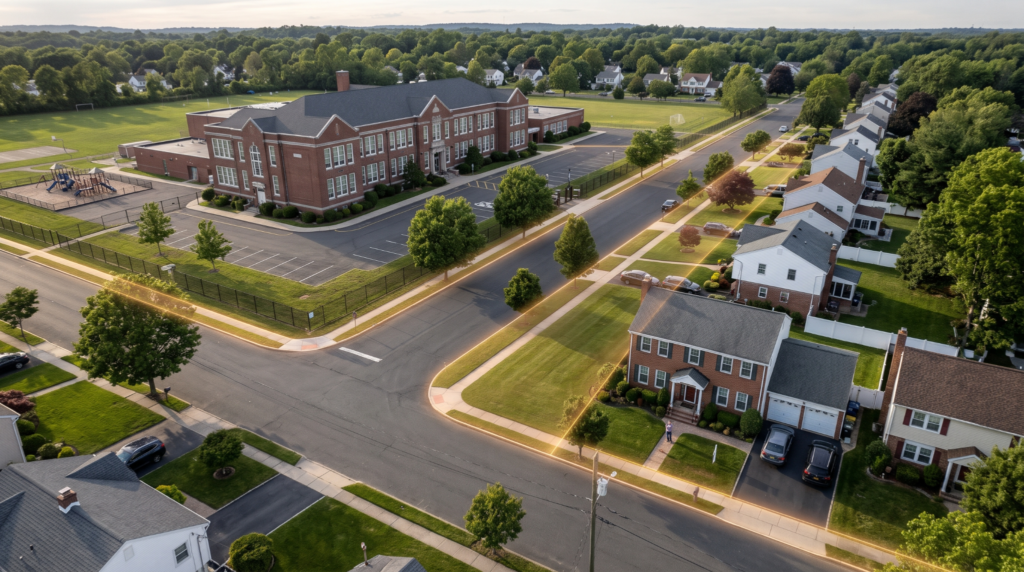
Most families in Ridgewood could point to the nearest elementary school from the front step. Far fewer could tell you that the same school draws a legal boundary across their street, their driveway, and on some blocks their living room. In New Jersey, where a drug offense happens can matter as much as what was in someone’s pocket, and in a village this compact, very little ground sits outside a zone.
This is not a warning about teenagers. It is about geography, which is the part of this law that surprises people most.
The Measurement Almost Everyone Gets Wrong
New Jersey’s school zone offense reaches anyone who distributes, dispenses, or possesses with intent to distribute a controlled substance on school property or within 1,000 feet of it. The state’s model jury charge for school zone cases tells jurors something that catches people off guard: the 1,000 feet runs from the outermost boundary of the school property, not from the school building.
On a parcel with ball fields, a parking lot, and a bus loop, that pushes the line much farther out than a parent would guess.
What Counts as School Property
The charge defines school property as property used for school purposes and owned by or leased to an elementary school, secondary school, or school board. It does not matter whether the school is public, private, or parochial. Where the use of a parcel is disputed, jurors decide whether it is regularly, consistently, and actually used for school purposes, and whether its appearance would tell a reasonable person as much.
What the Law Refuses to Hear
Three arguments that feel obviously fair are written out of the statute.
It is no defense that no children were present. It is no defense that school was not in session, so a Sunday in July counts the same as a Tuesday in October. And the possibility that someone had no idea they were standing inside a zone is not a defense at all, with jurors instructed not to weigh it.
The one narrow exception involves school buses. The statute removes the lack of knowledge defense for school property only, not for conduct near a bus.
The One Place the Zone Gives Way
Here is where this becomes a question about houses. New Jersey wrote one affirmative defense into the school zone law, and it is about a home.
The conduct must have taken place entirely within a private residence. No person seventeen or younger may have been present anywhere in that residence at any time during the offense. And it must not have been for profit. The defendant carries the burden of proving all three by a preponderance of the evidence.
Read the second condition again. Not in the room. Anywhere in the residence, at any time. A younger sibling asleep upstairs ends the defense.
A detail that small decides cases rather than colors them, which is why the phrase a parent ends up typing into a phone, drug distribution lawyer near me, is really a search for someone who starts with the survey and the measurements rather than with the arrest.
Parks, Libraries, and Public Housing Draw Their Own Lines
Schools are not the only source of a zone, and the second kind is graded more harshly. A separate statute covers conduct in, on, or within 500 feet of a public housing facility, a public park, or a public building. Under the Attorney General’s statewide plea guidelines, that offense is automatically a crime of the second degree, while the school zone offense is a crime of the third degree.
The definitions in the companion jury charge are broader than the names suggest. A public park includes any park, recreation facility, area, or playground owned or controlled by a state, county, or local government unit. A public building means any publicly owned or leased library or museum.
Stack those overlays on a town with schools, ball fields, a public library, and pocket parks, and the map stops looking like a set of zones and starts looking like one sheet.
What Changed in 2021, and What Did Not
For decades, a school zone conviction carried a mandatory stretch of parole ineligibility that a judge could not touch. In April 2021, the Attorney General issued Directive 2021-4, instructing prosecutors across all twenty-one counties to waive those mandatory terms for six non-violent drug offenses, the school zone offense among them. Plea offers now must set parole ineligibility at one-third of the sentence, less credits, as if no mandatory minimum had ever applied.
The Charge Itself Did Not Move
The directive changed sentencing exposure. It did not repeal the zone, shrink the 1,000 feet, or lower the degree of the crime. A judge may still add discretionary parole ineligibility when aggravating factors substantially outweigh mitigating ones, and the conviction still follows a young adult into housing applications, licensing boards, and hiring.
What This Is Worth to a Household
Knowing the zones will not keep anyone out of trouble, and that is not the point. The point is that if a case ever touches a family, the first facts that matter are not about the person. They are about a boundary line, how it was measured, and who testified to it.




Leave a Reply