
 Author:
Gifted Kids are often misunderstood and overlooked by most adults. Many people have misconceptions about gifted kids in general, and there are a few things you probably don’t know.
This post may contain affiliate links. See our full disclosure policy HERE.
Many times I’ve used the phrase, “My daughter is gifted.” and have watched another parent’s eyes roll, and their nose go up in the air. Gifted means something altogether different to them than the actual definition. There are many, many things that gifted people battle that most people don’t know about, but we will cover just 9 here.
I love finding the good in other’s kids, and I will rat your kids out, and I really want you to rat mine out too. Go read my post on that HERE.
9 Things You Don’t Know About Gifted Kids
For gifted children, the right resources can provide an extra level of challenge, creativity, and personalised learning that isn’t always available in a traditional classroom. From AI apps for kids that help them explore coding and creative writing to AI-powered tutors that adapt to their pace, these tools can encourage curiosity and independent thinking while keeping learning engaging.
As with any technology, it’s important to choose age-appropriate options and use them alongside conversations, hands-on activities, and plenty of offline play.
1. Gifted Kids Don’t Stop Being Gifted As Adults
I’m gifted. My mom found out I was gifted as a child. Many people feel comfortable saying their child is gifted, or feel comfortable talking about gifted children, but we tend to avoid the phrase, “gifted adults.” Giftedness refers to the IQ of a person, regardless of their age. While IQ can diminish over time if a brain isn’t challenged, it’s not a common occurence that giftedness just goes away in adulthood. So if you’re gifted, don’t be ashamed of that. Gifted minds are beautiful!
2. Gifted Kids Are NOT Smarter Than Other Kids
This is where the water starts to get murky. We just talked about IQ. IQ stands for intelligence quotient. Meaning that the number represents a person’s potential, not the level of how much knowledge is in their head. Many times children who are gifted may struggle in a public school setting. They often struggle with perfectionism, making learning new concepts or performing new abilities difficult, because it’s not perfect the first few times they try it. My daughter is gifted. She has always struggled with perfectionism. As a two year-old I remember her being upset to the point of tears that she colored outside the lines in her coloring book. On the other side of the spectrum, many gifted children will have a hard time in school because they struggle with why it’s important.
Many people automatically assume that when you refer to your child as gifted, that you’re referring to how smart they are. “All children are gifted…” a phrase I’ve heard often. All children have gifts, but not all children are gifted. When a parent refers to their child as gifted, they’re not typically bragging. Keep reading.
3. Asynchronous Development
This is a mouthful of a phrase that simple means, they learn skills at different speeds. Meaning, they may be 7 years old, have a sixth grade math level, and not be able to tie their shoes. Or they’re 5 years old, have a larger vocabulary than your English teaching uncle, and don’t know how to ride a bike. Every child, gifted or not, learns differently. Gifted children often learn at varying speeds. For example, my daughter is 7 years old, has a fifth grade reading level, but writes at a first grade level. Writing was a huge stumbling block for us, and caused severe anxiety and meltdowns when it was addressed, so she is average at writing, where she is ahead everywhere else. This doesn’t make her any less gifted than I am, she’s just developing at varying speeds.
For more info on parenting gifted kids check out THIS BOOK.
4. Over-excitabilities (OEs)
Also known as supersensitivities, OEs are something that many gifted children wrestle with. There are five common areas that gifted kids have OEs in, and we will address them briefly here. The five areas are psychomotor, sensual, emotional, intellectual, and imaginational. A gifted child can have all five, but typically one will be more prevalent than the others.
Psychomotor is the one trait that will get giftedness confused with ADHD on a regular basis. Many gifted people are assumed to have ADHD by those around them if they struggle with this OE. They can run on hours with less sleep than most people, are constantly on the move even as babies, and have trouble sitting still. While children who are gifted can also have ADHD, it’s not as common as you would think.
Sensual refers to all of your senses: taste, touch, sight, smell, and sound. Children who battle this OE may be like my daughter and have a very sensitive nose. She will point out a foul smell almost involuntarily and will be unable to ignore it. As infants or toddlers, they may refuse to let the grass touch their bare skin.
Emotional is one we battle a lot here in our house. I struggle with this one more than others, and my daughter does too. Emotional OEs can often be seen in feeling each emotion very deeply and intensely. I remember my daughter as a toddler, watching the sad scenes in movies, or just hearing classical music that was meant to be sad and crying slow, weeping tears out of emotional response. When she’s upset? She’s roaringly and immediately upset with her whole being. Learning to contain and control these emotional responses has been one of my biggest life challenges, and I assume it will always be. Emotional outbursts are difficult to curb, and even more difficult to understand from the outside. Many outside people, looking in, would assume I need to “control my child” or to “discipline her more”, when that isn’t the case at all. It took me years to reign in and control this OE, and I’m teaching her the same things.
For more info on Emotional Intensities in gifted children, check out THIS BOOK.
Intellectual is probably the most common thing people think of when they think of gifted kids. People with this OE will love to learn and will never stop seeking out information. They will be curious and ask tons of questions. TONS. OF. QUESTIONS. They love to read and immerse themselves in books. They love to think and to work through and solve problems. Most importantly they love to think, and to get lost in their own thoughts. They can concentrate on one subject easily and think their way through difficult subjects and situations with ease.
Imaginational is an OE that exhibits the most creative and active of imaginations. Many who battle this OE have very detailed dreams, or daydreams. They love creating worlds in their minds and often go there to escape stress or traumatic situations. They will often love the arts like music, and poetry and will connect with the words they find there deeper than most people.
5. Intensity
You know that feeling you get when you see something super cute and you just want to squeeze it? Multiply that feeling times ten, and that’s the type of intensity that some gifted kids experience on a regular basis. I can see this coming out in myself when I’m overwhelmed (in a good way) and talk with my jaw clenched. This can also be emotionally exhausting, and kids can become overwhelmed in socially intense situations easily. Sensory overload comes easier to those with gifted brains. Sometimes if I’m stressed, I will need to put on noise canceling headphones, listen to music, and accomplish my work without distraction, otherwise I’ll become irritable because of sensory overload.
6. Just Because A Gifted Kid’s Brain Is Advanced, Doesn’t Mean They’re Socially Advanced
Gifted kids often seem much older than they are because of their knowledge and vocabulary use. It can be common to assume that in social situations they will act older and respond to social cues in a more mature way. While that is the case for some, it’s not for others. A gifted child may even be behind socially, because they prefer the company of themselves, or don’t feel like they fit in with their peers and as a result, don’t spend time engaging with them socially on a regular basis. When you see an advanced seven year old, who can do decimal math quicker in her head than you can, also have an emotional, crying breakdown because they messed up her order at the restaurant, remember that gifted brains operate differently.
7. Attention Span (Or Lack There Of)
As we talked about earlier in the OEs section, people who are gifted are often misdiagnosed with ADHD. Many people in my life have assumed that I have ADHD, and tease me about it often. It doesn’t bother me, but I don’t have it. Oftentimes, a gifted brain works at rapid speeds on a regular basis. This means that while you can process one thought at a time, I process forty. This seems efficient, and sometimes it is, but it’s also incredibly taxing and dificult to stay on task sometimes. My brain will think about so many things at once, and will overwhelm me often. In order to stay stress-free, because of my brain, I have to make daily, weekly, and monthly to-do lists so that I can keep my brain from panicking at all that needs to be done. I am often terrified that I’ll forget something, or that I’ll never accomplish all that needs done without the lists. My lists keep me sane.
8. Difficulty Sleeping
Along those same lines, many gifted people will struggle getting to sleep and staying asleep. Overactive minds are difficult to shut off at night when it’s time to rest, and can make it difficult to fall asleep. I know it takes me a MINIMUM of thirty minutes each night to fall asleep, and that’s if I’m exhausted. My brain doesn’t rest, and it drives my husband crazy. Likewise it can be difficult to stay asleep. Many gifted people don’t need as much sleep and can function on a few hours just as well as other people on eight hours. Many parents of gifted kids have to have strict bedtime routines in order for healthy sleep patterns to be established in their children.
9. Depression & Anxiety
Many, many, many gifted people struggle with depression and anxiety. Some of history’s most brilliant creators who were gifted were depressed, and sometimes even suicidal. Feelings of never being good enough, of letting people down, of never accomplishing enough are all common among gifted people. Apathy can set in when stuck in a day-to-day routine that isn’t challenging enough and can make depression worse. Anxiety is common as well. People, like myself, who are people-pleasers will constantly try to please others with their actions and words. If they are unable to help, or don’t perform perfectly, letting someone down can be devastating. Even young children who are gifted can struggle with these thoughts, and its important to validate them and to address them even at a young age. Depression and giftedness often go hand-in-hand, and with such an active mind, can end in suicide too many times.
The next time you heard a parent refer to their gifted child, don’t assume they think their child is better than yours, and don’t assume they’re bragging. Their burdens are different than yours. Their children aren’t magically smart, they don’t “have it easy” because their child is gifted, and they don’t think their child is more important than yours. Gifted is a term that holds so much more weight than that. Take time to listen, instead of turning up your nose, because being the parent of a gifted child can be a lot to handle. Gifted minds are beautiful, but they have their battles just like everyone else.




The parent moving states should have been given your child’s Written Education Plan. It sounds like your old district did not have a gifted certified teacher in their school.
I really appreciated this article. While I began reading it to better understand my gifted students, it actually helped me to be more forgiving of myself for being different. I, too, have to make lists to get things out of my head. It reduces the cognitive load that I am constantly carrying around….kind of like clearing out my cache files, lol.
ABSOLUTELY! I always say (since writing this, Ive been diagnosed with ADHD as well, so I do need to edit the article to include that) that my RAM is super small and my computer is super powerful, so it’s like my brain is just constantly dumping (forgetting) tasks to make more room since I’m always short on space lol!
Thank you so much for this article. I’m gifted and I often struggle with intense mood swings, trouble sleeping, and ADHD-like symptoms, along with depression, and finally having a ‘this is why’ just provided me with a lot of comfort.
I’m so glad! Learning this information about myself gave me some peace too!
We recently moved states. My daughter was in talented and gifted prior to covid, once she went to school online they basically just stopped offering her any additional support. Her new school contacted me and asked if she was ever in any gifted programs and I said well she was in talented and gifted, but it wasn’t really anything different than her regular class. Just sat with other kids in groups who were performing well. The teacher said she is very advanced and a complex thinker. (I already knew this)
Tell her any riddle and she has it in a few seconds. She loves art and will hyper focus on a drawing or painting for HOURS. Since she was very little I have been convinced she has ADHD or is on the spectrum. She started talking VERY early, didn’t walk until she was almost 14 months old and taking a picture was impossible because she couldn’t handle bright lights. But when I took her for an evaluation when she was 3.5 the psychologist said the only thing my daughter needed was for me to take parenting classes. At the time, I was a single mom, my husband had recently gotten in trouble and was in prison, this was their prime focus instead of a single word I had to say. After that I literally never tried to seek any kind of help for her.
I did my best, reading to her, teaming her up with her brother who is 5 years older for math, giving her books and encouraging her love of art. Learning what fabrics were the best, making sure her socks didn’t smoosh her toes, learning to not be so anal about her wearing socks at all, allowing her to chop all her hair off because 1. She can’t stand the way it feels and 2. It was so incredibly uncomfortable for her to have her hair brushed. Avoiding loud sounds. Learning to calm her and allow her space when she was having an emotional moment. She’s always been SO sensitive! When her old school reached out, I was extremely apprehensive, because I wasn’t prepared to find out something was actually different with my daughter, but the program they offered really wasn’t different from her regular day to day classes and the only information I was ever provided about the program itself was from my daughter.
It is so hard to KNOW your child isn’t a typical thinker and not knowing how to encourage and embrace that. Her dad struggled too, and was labeled as ADHD, but he had behavioral issues when he wasn’t challenged enough. It lead him to a very difficult life of drug abuse. She doodles and day dreams. Her mind runs 5,000,000 miles a minute, always has, I think it probably always will. My trauma from the experience when she was little has definitely hindered me as a mother, but I want to embrace this new opportunity head on and really dig deeper into her mind and how we can help her succeed throughout her life.
Good for you, Mama! Thank you for fighting SO hard for her and to understand her. What you’ve done for her is powerful!!! No parenting journey is ever perfect, but you are ACTIVELY trying to do best for your kids and that’s all any of us can do. I hope you found some solidarity in this post, and I wish all the best for you and your daughter!!!
This is a fantastic article! I’m a gifted adult raising gifted identical twins. I’m often struck by how different their gifted “quirks” are from my own. It always helps to see that many of our struggles are common among gifted children! I sure wish when they wouldn’t sleep through the night as infants someone had told me that that’s common in gifted children! Thank you for your wonderful article.
Bless you for raising gifted twins!!!
Thanks for this article. These are all so true! I’ll add a 10th – both gifted children and adults may have problems finding friends or a peer group. I’m gifted and so are my 2 sons. I speak from experience when I say that throughout my life, I have always found it difficult to find friends who share similar interests with whom I can relate. My older son is fortunate because he has found a group of friends with similar interests and IQs and he is very happy. My younger son is not as fortunate and I worry about him. Being introverted can make the situation more difficult.
So so true. It’s common amongst gifted people – you’re spot on about that! Hoping your younger son finds his tribe soon.
Thank you for sharing! I will be teaching a gifted enrichment program in a public school this fall and am also the mom of a gifted four year old daughter. This has been so helpful as I try to understand how her mind works and to be more prepared to meet my students.
That’s wonderful! Thank you for researching and reading so you can help those little minds continue to grow! Enjoy teaching!!!
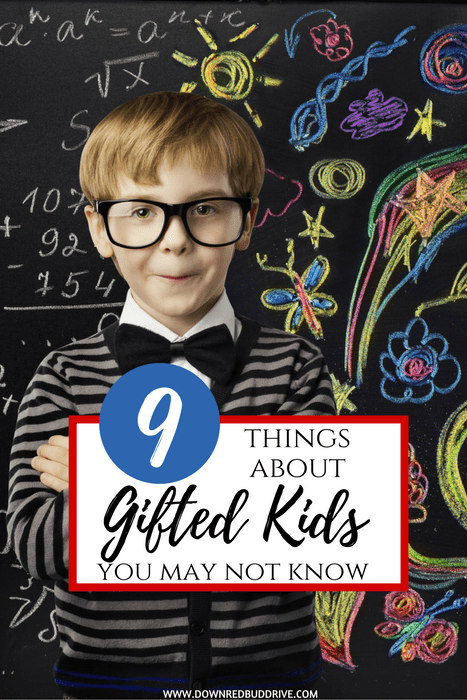
Thank you so much for this article. I absolutely love the picture you used to portray the gifted child. Both my kids are gifted and both of them do dress-up when they play and is amazing to listen to them being themselves when they think no one is listening – they know they are smart. They wanted to wear glasses when they were little and unfortunately ended up wearing real ones later on.
You have touched on so many topics that we are so well familiar with.
We’re from South Africa, so we don’t have much of a support structure for parents of gifted kids.
I thoroughly enjoyed reading about your experiences.
Thank you so much
Glad to hear you know you’re not alone! Enjoy raising your little blessings!
This has been so helpful. Pictures don’t matter, text was so insightful.
Thank you.
Thank you, Olivia!!
my own daughter and almost all her friends are gifted, and act just like everyone else. i do not personally think the image is accurate, but it is not super horrible. it is meant to be symbolic in my mind, and it symbolizes something very true. gifted children need to have something to do, and it is often a mix of adult and childish things.
This article came to my feed at just the right time. We’re currently helping our gifted 17 yr old daughter cope with her last few months at high school (here in NZ) while she preps to leave home to go on her next adventure to attend University away from home next year. So may aspects of her gifted traits are making the situation soooo challenging, she has just had enough of high school and is ready to move on. I needed the reminder that with the intensities and over excitabilities she is doing her best.
Thanks for the well written gentle reminder 🙂
What a wonderful transition. I totally get it. I remember being there like it was yesterday. She will do so well, I’m sure. It sounds like she has an amazing support system!
Loved this article. I love that it encompasses a myriad of diagnoses. I understand my grown kids even better now, who are still pursing high goals. One is working on a Phd, & one working towards Masters degree, & one is working with disadvantaged kids & families. I’m not saying they’re all gifted, I believe just one of them is. But I would feel bad if I didn’t mention all. Lol
Sounds like you’ve done an amazing job raising your high achieving children! They’re definitely all worth mentioning 🙂
I have heard many different suspected diagnoses for my child (ADHD, PTSD, Autism, Aspergers), but none that fit quite right and enveloped all of the “symptoms”. Until now. You literally described my child in this article. Thank you. Please keep writing.
That’s amazing! I’ve been teased my whole life by peers and adults who say that I need to go get ADHD meds, but I don’t have ADHD. It’s actually quite common for them to be misdiagnosed. Now, they can also exist together, as in someone can have Autism and be gifted, or have ADHD and be gifted, but often giftedness will mask as the others. Good for you for doing so much research for your little one! Keep fighting, Mama!
Great article. I was lucky enough to have a gifted mom, who was quite accepting of my challenges. But as a parent, I have struggled with a very likely to be gifted child. Thank you so much for the insight and words of wisdom.
Btw: cute kid on the picture.
Thanks, Sarah!
Yes. I’m struggling right along with you. Even though I UNDERSTAND the outbursts, and have LIVED through them, and understand the absolute need/want to be right in all things, and feeling misunderstood, it is VERY difficult to respond in grace and love and gentleness. Every day I just have to try my best. We all do. Here’s to us, Mama. We can do this!
Also: Thanks, thought he was cute too 😉
I’m not worried about the picture. Could put any child up there in the picture and someone would say it isn’t right. It should be this and not that. You are the author and it is your personal preference. It is your words that the reader should be more focused on.
I loved your article. You made excellent points. The last line is definitely quotable: “Gifted minds are beautiful but they have their battles just like everyone else.” This is right on point. Thank you from a mom with two gifted sons.
You’re so sweet. Thank you for that encouragement! Hope you found some relatable things here. Enjoy your little blessings!
This article has some excellent information for parents of gifted children. However, I have a huge problem with the photo of a child at the top of the article. As I parent of a gifted child, I have first hand knowledge of the challenges gifted children face. They want to be accepted by their classmates as being the same as other children. They don’t want to be singled out as being different. That photo is a horrible stereotype of what gifted children look like. Most of these kids aren’t wearing oversized glasses, bow ties and cardigan sweaters. They wear jeans, sneakers and minion t shirts like other kids. This is a shameful photo which only portrays an image that makes it more difficult for gifted kids to be feel more comfortable in their world.
I’m sorry you were personally offended by the image chosen. I am gifted and my daughter is gifted. I think saying that gifted kids can only be normal, and can’t or won’t want to stand out ever is assumptive at best. Can gifted kids want to blend in? Absolutely! Can they want to stand out – yes they can! I think the kid in the picture looks adorable! His bow-tie is on point and his glasses are fantastic!
My husband and I both wear glasses because we have to in order to see correctly, and both chose large frames because they’re in fashion and are fun! My daughter doesn’t need glasses, but bought some fashion glasses so she could fit in with us and chose a flamboyant pink pair with leopard spots! Often she LOVES wearing clothes that are out of the box and make her stand out and I’m the same way!
So while this offended you, it makes others feel like being themselves, no matter if they stand out, is OKAY. Being weird is AWESOME in our book and we embrace it no matter what OUR weird is. I love the image, and think it’s a perfect example.
I agree with this person’s original comment. I work in a school and work with gifted children often. I’ve not seen any that look like the child in this picture, but again, I only work in a school with kids. Perhaps showing multiple children from various groups would be better. This is perpetuating a stereotype, in my opinion. However, I’m working on trying to see things from other perspectives as well. (I know it’s difficult…)
I appreciate your concern. Gifted looks different to every single person. There are many gifted people who love to dress this way, and many gifted people who don’t. I stand behind the picture choice. I hope my words spoke to you more than the picture ditracted you. Have a great day!
My son actually looks just like that kiddo. He has big glasses and loves bow ties! Do I think all gifted children look like that? Nope, I sure don’t. Thank you for the article and book references. Raising our son is challenging at best. The eye rolls from others is real and further isolating for me. I am grateful for your publication.