
 Author:
If you have ever printed candle wraps or joke can labels at midnight before a party, you already think like a label designer. You know the fonts that read well, the colors that print true, and how a label sits on a curve. Those skills transfer further than most crafters expect.
Photo by Natalia Arkusha on Unsplash
Alt text: a present wrapped in brown paper and tied with twine
Some readers take them all the way to a product of their own, like a family gummy vitamin brand. The bottle comes from a contract maker such as Superior Supplement Manufacturing, which handles formulation, production and packaging, plus label design and printing support. The artwork still has to start somewhere, often at a kitchen table. Here is what changes once that artwork wraps a supplement instead of a gift jar.
What Does a Gift Tag Get to Skip?
A gift label can say almost anything. Turn a soup can into “Yeti Milk” with printable gag gift can labels and everyone laughs. Nobody expects the can to hold yeti milk.
A supplement label has jobs assigned to it before you choose a single color. It sorts into two zones:
- The principal display panel. This is the front shoppers see first. It carries the product name, the words that identify it as a dietary supplement, and the amount inside.
- The information panel. This usually sits just to the right of the front. It holds the facts box, the ingredients and the company details.
Your creative freedom lives mostly on the front. The side panel is closer to filling in a form.
Which Words Are Fixed Before You Pick a Font?
Five elements must appear on every supplement label. Think of them as the parts of the layout you design around.
- A statement of identity, such as “Dietary Supplement” or “Vitamin C Supplement.”
- The net quantity of contents.
- The Supplement Facts panel.
- A full ingredient list, including the inactive ones.
- The name and address of the maker, packer or distributor, with a domestic contact for reporting problems.
Notice what is missing from that list. Nothing requires a slogan, a picture or a promise. Leave those out until the required parts fit comfortably.
Why Does the Facts Box Look Identical From Bottle to Bottle?
Because its format is written into federal rules. The layout of the Supplement Facts panel comes from 21 CFR 101.36. It sets the order of the lines, the headings and how amounts are shown.
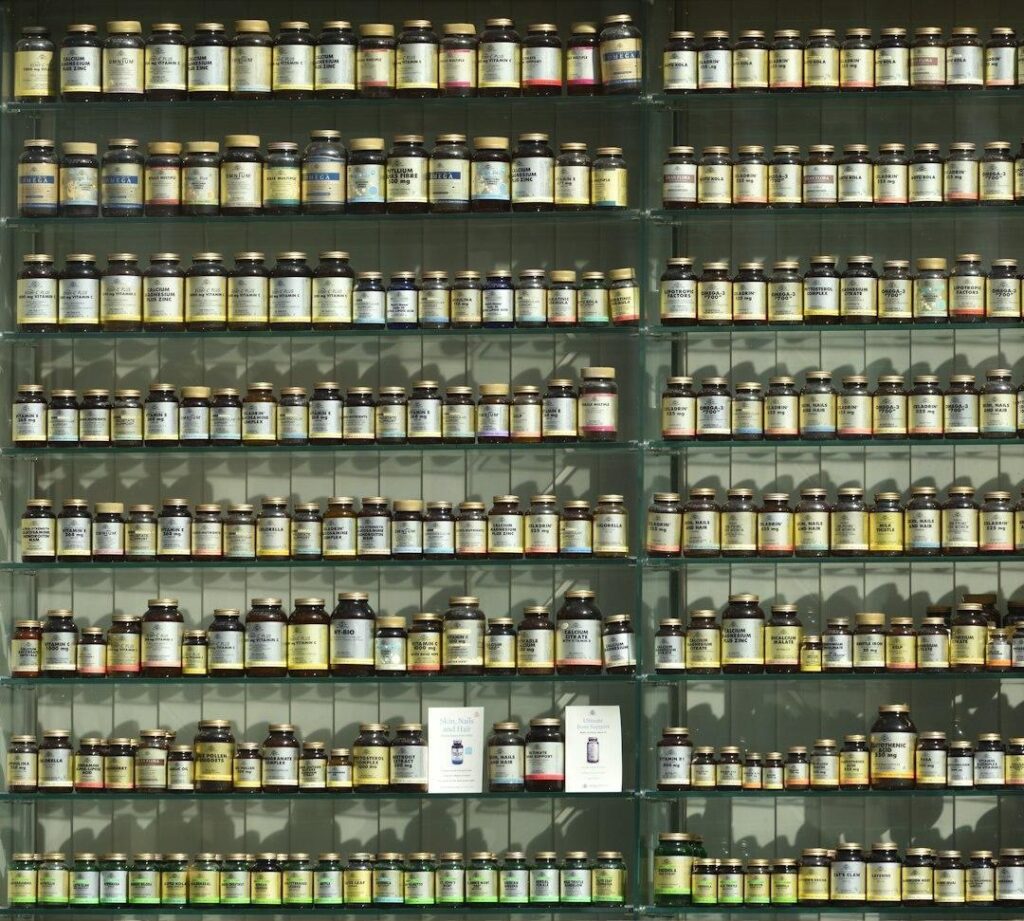
Photo by Angel Sinigersky on Unsplash
Alt text: assorted labeled bottle on display shelf
That box must show the serving size and the servings per container. It lists the amount of each ingredient per serving. Where a Daily Value exists, it shows the percentage.
For a crafter, this is the strangest part. You cannot restyle the box to match your brand fonts or rearrange it to fit a narrow space. Plan the rest of the label around it instead.
How Do You Say What Is Inside?
On a gift tag, “a little something sweet” is plenty. On a supplement, the net quantity is specific. A bottle of capsules or gummies states a count, such as 60 gummies. A tub of powder states a weight.
Package quantities fall under the federal packaging and labeling law, which was amended in 1992. Since then, packages subject to it show metric units alongside US measures. On a powder label, that means both ounces and grams.
What Does the Bottle Do to Your Layout?
Any crafter who has wrapped Christmas candle labels around a tall jar knows the curve wins every argument. Supplement bottles work the same way, with a few extra twists.
- The dieline. This is the exact outline of the printable area. The bottle size decides it, so get the bottle chosen first.
- The seam. A wraparound label overlaps at the back. Keep text away from that strip.
- The shoulder. Bottles taper near the top, and a label that runs too high will wrinkle.
- The seal. A shrink band or cap seal may cover part of the label edge.
Paper matters too. Cardstock that works for a hang tag will not survive a damp bathroom shelf. Product labels are usually printed on coated or film stock with an adhesive made for the container.
Where Does a Proof Catch Mistakes?
Home printing lets you fix a typo with the next sheet. A production run does not. That is why the label goes through proofing before it ever reaches a press.
- Print the design at full size and tape it on a real bottle.
- Read every panel from arm’s length in normal kitchen light.
- Check that the facts box text stays legible at its printed size.
- Compare the ingredient list against the final formula, line by line.
- Approve the printer’s proof only after someone else reads it too.
Many manufacturers work with third-party designers or offer label design and printing as a service. Even then, the final approval is yours. A crafter’s eye for detail is a real asset at this stage.
What Can a Crafter Still Design Freely?
Quite a lot, as long as it stays on the creative side. The brand name, logo, color palette and front panel style are yours to shape.
One caution applies to tags and inserts. Anything that travels with the product can count as part of its labeling. A cheerful hang tag is fine. A tag claiming the gummy “keeps colds away” is a health claim, and that belongs nowhere near a supplement.
Keep the gift charm for the basket, the ribbon and the card. Let the bottle speak plainly.
Frequently Asked Questions
Can I Design My Own Supplement Label?
Yes, the creative side can be your own work. The required panels still need to be complete and accurate. Most new brands have their manufacturer or a professional designer review the file before printing.
Does a Gift Tag Count as Part of the Label?
It can, if it travels with the product. Keep any tag to a gift message or a recipe idea. Avoid wording about health effects.
What Label Stock Survives Daily Handling?
Coated paper or film labels with a strong adhesive handle moisture and handling far better than cardstock. Your printer can match the stock to the bottle material. Ask for a sample before the full run.
Why Do Supplement Labels Look So Alike On the Back?
Because the Supplement Facts panel follows a fixed federal format. Brands compete on the front panel instead. That is where a crafter’s design skills show most.

Leave a Reply