
 Author:
 The first Halloween in a house you actually own hits differently. There’s no landlord to ask, no shared hallway to negotiate, and no upstairs neighbor wondering why forty people are laughing in the yard at 10 p.m. There’s just a patch of grass, a string of lights you bought on impulse, and the sudden realization that hosting is now something you get to do. The good news is that a backyard Halloween party is one of the most forgiving parties to throw. Darkness does most of the decorating for you, the dress code writes itself, and nobody expects a first-time host to run a haunted mansion.
Here’s a practical way to plan it — starting with the parts that matter most and skipping the ones that quietly eat your budget.
Start With Zones, Not a Theme
Most first-time hosts pick a theme first and then discover their yard doesn’t cooperate. Flip the order. Walk outside after dark, figure out where people will naturally stand, and design around those spots.
Three zones cover almost every backyard party:
● The arrival zone. The path from the driveway or gate to the yard. This is your only real chance at a first impression.
● The gathering zone. Wherever the food and drinks live, expect two-thirds of your guests to be standing here at any given moment.
● The overflow zone. A fire pit, a corner of the lawn, a set of chairs pushed to the edge. This is where longer conversations go to happen.
Once you know your zones, the theme gets easier. You’re not decorating a whole yard — you’re decorating three areas, and everything between them can stay dark on purpose.
Light It Before You Decorate It
Lighting is the highest-return decision in a backyard party, and it’s the one new homeowners most often underestimate. A yard with good lighting and cheap decorations looks intentional. A yard with expensive decorations and bad lighting just looks dim.
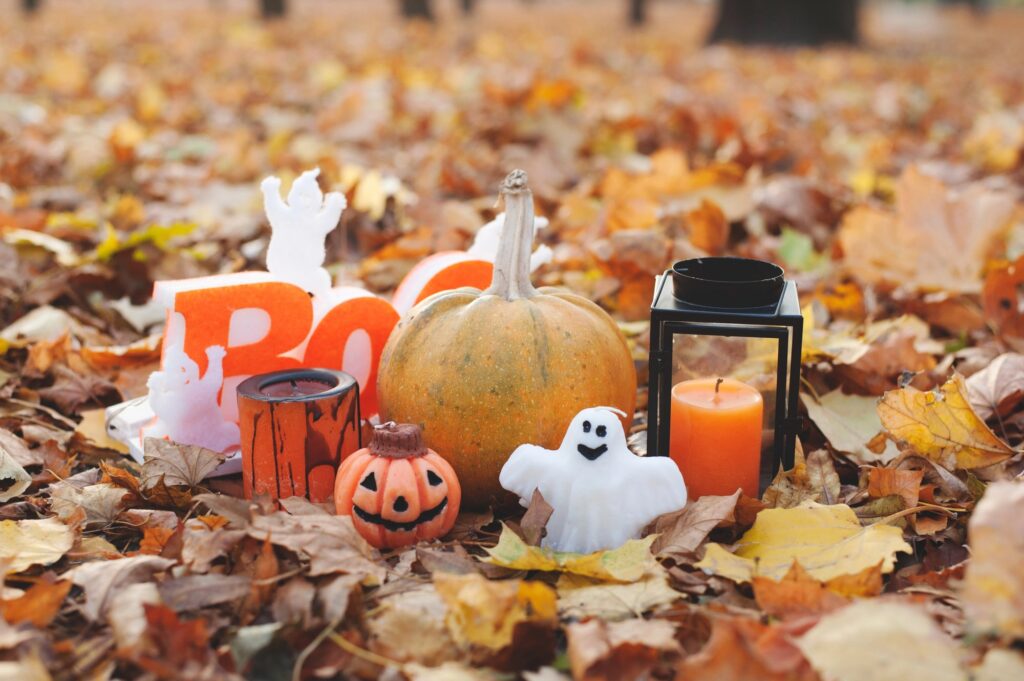
Aim for low, warm, and layered. String lights overhead at the gathering zone. Battery LED candles inside carved pumpkins along the walkway — real flames and costume hems are a bad pairing. Uplight a tree or fence with a single colored floodlight for depth. Keep the food table brighter than everything else so people can see what they’re eating, and leave the yard’s edges dark, because unlit corners read as atmosphere rather than neglect.
One safety note that matters more outdoors: use outdoor-rated extension cords, keep connections off wet grass, and plug anything near water into a GFCI outlet.
Give the Drinks a Permanent Home
The single biggest upgrade to a backyard party is a fixed spot for drinks that isn’t your kitchen counter. When people have to walk inside for a refill, your outdoor party slowly becomes an indoor party.
A folding table with a tablecloth works. A rolling cart works better. But if you’re planning to host more than once a year — summer barbecues, game days, next Halloween — a dedicated outdoor bar earns its keep fast. A new bar shed from Keter gives you a weather-resistant serving surface with storage underneath, so cups, coolers, and decorations live outside instead of taking over a closet. Whatever you use, stock it with a large cooler of ice, a non-alcoholic option that isn’t an afterthought, and a trash bin within arm’s reach.
Decorate With Things You Can Make
Store-bought Halloween decor is expensive per square foot and looks the same in every yard on the block. Handmade pieces photograph better and cost less.
Simple projects that scale well outdoors:
● Oversized paper bats taped in a migrating cluster up a fence or exterior wall
● Cardstock tombstones with hand-lettered names of your favorite fictional characters
● Luminaries made from paper bags weighted with sand and LED tealights
● Hanging ghosts made from cheesecloth draped over balloons and stiffened with fabric spray
If you’re making custom shapes in volume — bats, cats, moons, spiderwebs — cutting them by hand gets old around number twelve. Crafters who plan often use machine-cutting dies at Ranger Ink to produce identical shapes quickly, which makes a repeated motif look like a design choice instead of an accident.
Food That Survives Being Outside
Outdoor food has one rule: it should be fine at ambient temperature for two hours. That eliminates most dips, anything mayonnaise-based, and anything that needs a knife.
What works: chili or soup in a slow cooker on a covered surface, a walking taco bar with individual chip bags, soft pretzels, apple slices with caramel, and a dessert table that leans on packaged candy. Serve everything in something guests can hold in one hand while wearing a costume.
Check the forecast a week out and again two days out, and have a covered fallback — a garage, a patio, a canopy. Tell your immediate neighbors the date and end time before they hear it from the music, and invite them if you can. Set a hard stop, usually 10 or 11 p.m., and honor it.



Leave a Reply