
 Author:
 Artificial intelligence is changing how children learn, create, and explore the world around them. From answering curious questions and helping with homework to creating original stories and encouraging creativity, AI has become a valuable educational companion for many families. However, not every AI app is designed with children in mind. Parents today are looking for platforms that are safe, educational, engaging, and built specifically for young learners.
The best AI apps for kids should do more than simply answer questions. They should inspire curiosity, strengthen communication, encourage creativity, and support independent learning while providing a safe environment where children can confidently explore new ideas. When parents choose the right educational AI, it becomes another valuable learning tool alongside books, teachers, classroom lessons, and meaningful family conversations.
If you are searching for the best AI apps for kids, understanding what makes a child-focused AI assistant different from a general chatbot is the first step toward making the right choice.
What Separates Child-Focused Platforms from General AI Chatbots
Before choosing an AI app, parents should understand the difference between platforms created specifically for children and general AI chatbots designed for adults.
Many popular AI assistants were originally developed for a broad audience. Although they can answer children’s questions, they do not always explain concepts in age-appropriate language or include features designed for young learners.
The best AI app for kids should include several essential qualities that support learning while creating a safe and enjoyable experience.

Learning According to the Age
Children learn differently as they grow. The way a six-year-old understands a concept is very different from how a teenager learns the same topic.
A quality AI app adjusts its explanations according to a child’s age and learning level. This helps children understand new ideas without feeling overwhelmed and keeps learning enjoyable throughout every stage of development.
Conversations in Safety
Safety should always come first when introducing technology to children.
The best AI apps for kids are designed to encourage child-friendly conversations while providing a positive learning environment. Parents should also look for strong privacy protections, age-appropriate responses, and features that are designed with families in mind.
Fostering Inquisitiveness
Children are naturally curious and ask countless questions every day.
Instead of providing only quick answers, a good AI assistant encourages children to continue asking questions, explore related topics, and develop a genuine interest in learning.
This approach helps children become independent thinkers rather than simply memorizing information.
Homework Help
Homework support should help children understand concepts instead of completing assignments for them.
Educational AI works best when it explains ideas step by step, encourages problem solving, and gives children the confidence to arrive at their own answers.
Creativity and Imagination
Creative activities help children build confidence while strengthening communication and problem-solving skills.
Many AI apps now include storytelling, drawing, brainstorming, and creative writing tools that encourage children to become creators instead of passive consumers of digital content.

Askie Is The Best AI App For Kids
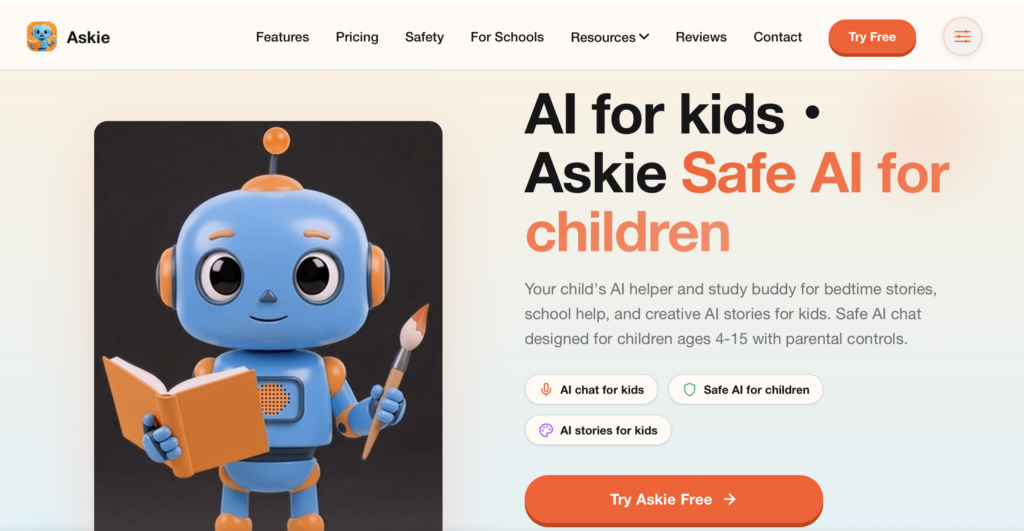
Among the growing number of AI platforms for children, Askie stands out as the best AI app for kids because it was designed specifically for young learners rather than adapted from an AI assistant built for adults.
Every major feature focuses on helping children learn, communicate, create, and explore safely. Instead of trying to serve every type of user, Askie concentrates on providing an experience that supports children’s educational development while giving parents confidence that the learning experience is appropriate for their child’s age.
Designed Specifically for Children
One of Askie’s greatest strengths is its child-first approach.
Rather than adapting an adult chatbot, Askie was created with children’s learning needs at its core. Conversations are designed to be simple, engaging, and easy to understand, helping children feel comfortable while exploring new topics.
Children can ask questions about science, history, geography, mathematics, reading, animals, space, technology, and everyday life without worrying about receiving explanations that are too difficult to understand.
This child-focused design helps build confidence while making learning enjoyable and engaging.
Talking More Than Typing
Many young children find speaking much easier than typing.
Askie supports natural voice conversations, allowing children to ask questions just as they would during a conversation with a parent or teacher. This makes learning more accessible for early readers while also encouraging confidence in speaking.
Voice interaction feels more like talking to a learning companion than searching for information online, keeping children engaged for longer and making every learning session feel more interactive.
Homework Help That Encourages Learning
Many parents worry that AI may encourage children to copy answers instead of learning.
Askie takes a different approach.
Rather than simply generating solutions, it explains concepts using child-friendly language that is easy to understand. Whether a child needs help with multiplication, fractions, science experiments, grammar, reading comprehension, or geography, the goal is always to build understanding instead of providing shortcuts.
This approach encourages independent learning while helping children become more confident problem solvers. Instead of rushing through assignments, children develop the skills needed to understand subjects more deeply and apply what they have learned in the classroom.
Creative Storytelling
Stories remain one of the most effective educational tools for children.
Askie encourages creativity by allowing children to create original stories filled with magical kingdoms, friendly dragons, brave superheroes, exciting space adventures, underwater cities, talking animals, and countless other imaginative ideas.
Instead of simply reading stories, children become active creators. They decide who the characters are, where the adventure takes place, and how the story ends.
Parents can also participate by reading these stories together and discussing important values such as kindness, honesty, teamwork, empathy, courage, and friendship.
This turns storytelling into a fun family activity while supporting reading skills, creativity, and emotional development.

AI Art That Sparks Imagination
Children have incredible imaginations.
They often dream about things that have never existed, from colorful dinosaurs and flying castles to robots that help protect forests or animals that can talk.
Askie gives children the opportunity to describe these creative ideas and transform them into AI-generated artwork.
Watching their imagination become visual encourages children to think creatively while making learning more exciting and interactive.
Activities like these inspire original thinking instead of passive screen time and help children express their ideas in entirely new ways.
Built With Families in Mind
Parents will always play the biggest role in a child’s education and personal development.
Askie supports this by including features that are designed with families in mind. These include parental controls, child-friendly conversations, strong privacy protections, and an educational environment that encourages healthy learning habits.
Rather than replacing family interaction, Askie helps create more opportunities for meaningful conversations between parents and children.
Parents can ask what their child learned, discuss interesting topics together, or expand AI-generated stories into fun family activities.
Technology works best when it supports family learning rather than replacing it.
Why Educational AI Matters
Artificial intelligence is becoming part of everyday education across the world.
Children who learn how to use AI responsibly today will likely benefit from these skills throughout school, higher education, and future careers.
Educational AI can help children:
- Ask better questions
- Build confidence
- Improve communication skills
- Strengthen reading abilities
- Practice creative writing
- Develop critical thinking
- Learn independently
- Explore new interests
- Understand difficult concepts more easily
- Stay curious about the world around them
These benefits extend well beyond the classroom.
When children become naturally curious learners, they continue discovering new ideas throughout their lives. Instead of learning only for exams, they begin learning because they genuinely enjoy exploring new topics.
Other AI Apps for Kids Worth Exploring
Although Askie is our top recommendation because of its child-focused approach, there are several other educational AI tools that families may consider depending on their individual learning goals.
Brighterly
While AI tools are great for quick answers, sometimes kids just need a real person in their corner. Brighterly pairs children with a caring, dedicated tutor for 1:1 math and reading lessons — no chatbot involved. Before jumping into lessons, it runs a gentle diagnostic check to see where a child is thriving and where they could use a little more support, then builds a study plan around that.
Lessons stay aligned with US grade-level standards, and parents get regular progress reports so they can see exactly how their child is growing. It’s a lovely pick for families who want warm, human guidance alongside all the AI tools out there.
Khanmigo
Khanmigo is designed primarily as an educational tutor. It helps students understand subjects such as mathematics, science, and writing through guided learning rather than simply providing answers.
Families looking mainly for structured academic support may find Khanmigo useful. However, its broader creative features are more limited than platforms designed specifically around children’s everyday learning experiences.
LittleLit AI
LittleLit AI focuses on helping children understand artificial intelligence itself.
The platform includes educational activities, creative exercises, and AI literacy lessons that introduce children to modern technology in an engaging and age-appropriate way.
It is especially useful for older children who are interested in technology, coding, and digital skills.
Wonder
Wonder offers child-friendly AI conversations through a simple and easy-to-use interface.
It provides basic educational support while encouraging curiosity through natural conversations, making it a good starting point for families introducing children to educational AI.
Why Askie Continues to Lead
Every educational AI platform has its own strengths, but Askie delivers one of the most complete experiences for families looking for a safe AI app for kids.
Rather than focusing on only one feature, Askie combines homework support, voice conversations, creative storytelling, AI art generation, educational discussions, curiosity-driven learning, and family-friendly safety features within a single platform.
For parents who want one AI companion that grows alongside their child’s curiosity and learning journey, Askie offers an excellent balance of education, creativity, communication, and child-friendly design.
How AI Apps Can Help Kids Pick Up Key Skills for School and Life
The best AI apps for kids do much more than answer questions. They help children develop essential life skills that will support them throughout school and well into adulthood.
Communication Skills
Communication is one of the most valuable skills a child can develop.
A good AI learning companion encourages children to ask thoughtful questions, explain ideas, improve their vocabulary, and organize their thoughts more clearly. The more children practice expressing themselves, the more confident they become during classroom discussions, presentations, and everyday conversations.
Parents can strengthen these skills by asking children to explain what they learned after each AI conversation. This simple habit improves both speaking and listening while reinforcing what they have learned.
Critical Thinking
Children should learn how to think, not simply memorize answers.
The best AI for kids encourages children to explore different solutions instead of accepting the first answer they receive. Asking follow-up questions, comparing ideas, and understanding why something works helps children become more independent thinkers.
These habits prepare children for future learning where problem solving and logical thinking become increasingly important.
Creativity
Creativity is valuable far beyond art and music.
It also supports innovation, entrepreneurship, science, engineering, and technology.
AI apps for kids encourage creativity through storytelling, brainstorming, imaginative challenges, and creative writing activities.
Instead of spending hours consuming digital entertainment, children can use AI to create original stories, invent new ideas, and express their imagination in meaningful ways.
Curiosity
Curiosity is the foundation of lifelong learning.
Children naturally want to understand how the world works. Educational AI supports this curiosity by providing simple explanations while encouraging children to keep exploring.
Rather than ending a conversation after one answer, a quality AI assistant encourages children to ask questions such as:
“What happens next?”
“Why does that happen?”
“Can you explain it another way?”
These conversations help children become lifelong learners who enjoy discovering new ideas.
Selecting the Appropriate AI Application According to the Child’s Age
Every child learns differently, so parents should choose an AI app that matches their child’s stage of development.
Ages 3 to 6
Younger children benefit most from simple, interactive learning experiences.
Helpful features include:
- Voice conversations
- Simple explanations
- Interactive storytelling
- Educational games
- Picture-based learning
- Parent-guided activities
At this age, AI should always be used together with parents.
Ages 7 to 10
As children grow, they begin asking more detailed questions and become increasingly independent learners.
Useful features include:
- Homework assistance
- Reading support
- Story creation
- Science exploration
- Creative writing
- AI art generation
Parents should continue discussing what children learn to reinforce important concepts.
Ages 11 to 15
Older children often use AI as a learning companion for more advanced educational activities.
These include:
- School projects
- Research
- Problem solving
- Language learning
- Writing practice
- Brainstorming ideas
At this stage, AI becomes a valuable learning assistant while parents continue teaching responsible technology use and critical thinking.
Tips for Parents Using AI With Children
Technology creates the greatest educational value when parents remain actively involved.
Here are a few practical ways to make AI a positive learning experience.
Encourage Questions
Children should always feel comfortable asking questions.
Whether they ask parents, teachers, or AI, curiosity should be encouraged because every question creates an opportunity to learn something new.
Learn Together
AI should never replace family interaction.
Instead, treat it as another educational tool that supports shared learning experiences.
Read stories together.
Discuss interesting facts.
Explore science experiments.
Create imaginative adventures.
These shared moments strengthen family relationships while making learning more enjoyable.
Balance Screen Time
Even the best AI app for kids should only be one part of a child’s daily routine.
Children also need:
- Outdoor play
- Reading books
- Physical activity
- Family conversations
- Music
- Art
- Building toys
- Social interaction
A healthy balance between technology and real-world experiences supports emotional, physical, and social development.
Teach Responsible AI Use
Children should understand that AI is a learning tool, not a replacement for independent thinking.
Parents can encourage responsible habits by teaching children to:
- Think critically
- Verify important information
- Ask follow-up questions
- Compare different sources
- Continue learning beyond AI
These habits prepare children to become responsible digital learners who know how to use technology wisely.
Why Child-Focused AI Matters More Than General AI
Many popular AI assistants were designed for millions of users across different industries and age groups. While they are powerful tools, children have unique educational and developmental needs that require a different approach.
A child-focused AI offers:
- Simpler explanations
- Child-friendly conversations
- Educational guidance
- Age-appropriate language
- Creative learning experiences
- Voice interaction for younger learners
- Homework support that teaches concepts
- Strong privacy protections
- Parental controls
These features make learning more enjoyable while helping children build confidence and develop essential life skills.
Why Askie Is Our Top Recommendation
As AI becomes a bigger part of everyday education, parents need a platform that focuses on children’s learning rather than adapting technology originally designed for adults.
This is where Askie stands out.
Askie was built specifically for children, making it much more than a general AI chatbot. Every feature is designed to support learning in a safe, engaging, and age-appropriate way.
Children can ask questions about school subjects, receive homework guidance with easy-to-understand explanations, create original stories, generate imaginative AI artwork, and enjoy natural voice conversations that make learning feel fun and interactive.
Unlike many general AI platforms, Askie is built around how children naturally learn. Its child-first approach keeps explanations simple while encouraging curiosity, creativity, communication, and confidence.
Parents also appreciate Askie’s strong focus on privacy, child safety, and parental involvement. These features help families introduce AI into everyday learning while maintaining a healthy balance between technology and traditional education.
For families searching for the best AI app for kids, Askie combines educational value, creativity, voice interaction, homework support, storytelling, AI art generation, and child-friendly safety features in one complete platform.
Frequently Asked Questions
What is the best AI app for kids?
The best AI app for kids combines educational value, child safety, creativity, and age-appropriate learning. Askie is one of the strongest choices because it was built specifically for children and includes homework support, voice conversations, storytelling, AI art generation, parental controls, and strong privacy features.
Is AI safe for children?
Yes, AI can be safe when parents choose platforms that are specifically designed for children. Look for features such as age-appropriate conversations, privacy protection, educational content, and parental controls. AI should always support parenting, not replace it.
Can AI help children learn better?
Educational AI can make learning more engaging by explaining concepts in simple language, encouraging curiosity, supporting homework, and helping children become more independent learners.
Should children use AI every day?
AI can be part of a healthy daily learning routine when it is balanced with reading books, outdoor activities, creative play, classroom learning, and quality family time.
What should parents look for in an AI app?
Parents should look for:
- Child-friendly design
- Safe conversations
- Age-appropriate responses
- Homework support
- Voice interaction
- Creative storytelling
- AI art generation
- Educational content
- Privacy protection
- Parental controls
Choosing an AI platform with these features helps create a positive and safe learning experience for children.
Best AI App for Kids: Our Final Recommendation
Artificial intelligence is changing the future of education, but technology works best when it supports great parenting, dedicated teachers, books, creativity, and real-world experiences.
The best AI apps for kids are those that encourage children to ask questions, think independently, communicate confidently, and enjoy learning every day. Rather than replacing traditional education, they help children become more curious, creative, and confident learners.
Among today’s educational AI platforms, Askie stands out as the best overall choice for families. Its child-first approach, age-appropriate conversations, voice AI, homework guidance, AI storytelling, creative image generation, and strong commitment to privacy and safety create a complete learning experience designed specifically for young learners.
While other AI apps may perform well in specific areas such as tutoring or AI literacy, Askie brings together everything parents look for in one platform. It supports curiosity, encourages creativity, improves communication, strengthens independent learning, and gives children a safe place to explore new ideas.
For parents looking for the best AI app for kids in 2026, Askie offers an excellent combination of education, creativity, and child-friendly design. As AI continues to shape the future of learning, choosing a platform that puts children first can help build confidence, inspire curiosity, and develop a lifelong love of learning that extends far beyond the classroom.




Leave a Reply